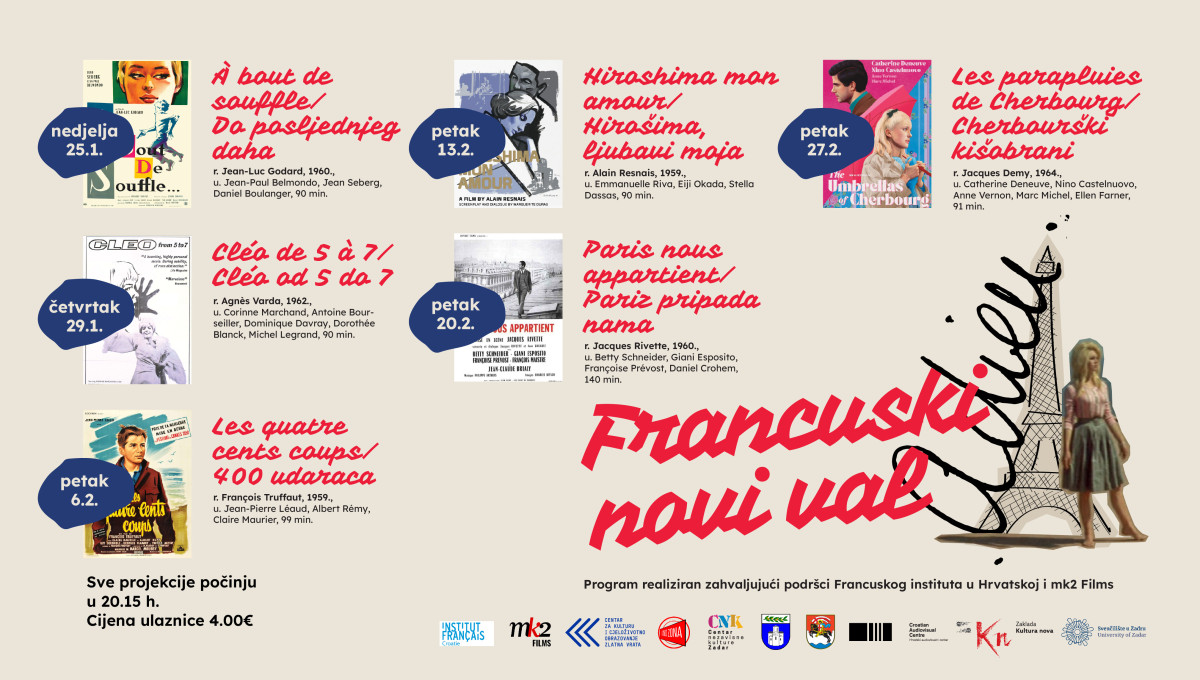
Linklater's New Wave, a love letter to the revolutionary magic of the French New Wave accompanied by excellent contextualisation from film scholars Bruno Kragić and Tomislav Brlek, served as the perfect introduction to our first film cycle of the year. In collaboration with the Split Cinematheque Zlatna Vrata and with the support of the French Institute in Croatia and MK2 Films, we present a special French New Wave cycle from 25 January to 27 February. This period is one of the most influential and exciting in the history of world cinema.
A movement that fundamentally transformed cinematic language in the late 1950s and early 1960s comes alive once again on the big screen. Rejecting the conventions of studio filmmaking, it foregrounded authorial freedom, youthful rebellion and a new aesthetic of reality. Key titles that defined a generation of filmmakers gathered around Cahiers du Cinéma are featured: Jean-Luc Godard, François Truffaut and Jacques Rivette, as well as the Left Bank auteurs Alain Resnais, Jacques Demy and Agnès Varda.
The cycle presents six canonical works of the French New Wave:
25 January - Breathless
A manifesto work of the French New Wave, Jean-Luc Godard’s gangster melodrama. One of the most influential films in French and world cinema, Breathless introduced a series of groundbreaking cinematic techniques, such as quotation and self-referentiality; the erasure of genre boundaries; the intertwining of fiction and documentary; handheld camera movement; breaking the fourth wall; and radical editing solutions, or 'jump cuts'. The film also anticipated the emancipation of youth and the revolutionary mindset that would emerge in the late 1960s.
29 January - Cléo from 5 to 7
A flâneur-like and eloquent portrait of 1960s Paris — a city unfolding through a female gaze. It is a chronicle of the passage of time and of how women see the world and how the world sees them. One of Agnès Varda’s key works, it brought her international acclaim after premiering in competition at the Cannes Film Festival.
6 February - The 400 Blows
Based on autobiographical details from François Truffaut’s childhood, this foundational work of the French New Wave features a young, rebellious and non-conformist protagonist whose sensibility perfectly resonated with the prevailing mood of the time, resulting in major commercial success.
13 February – Hiroshima Mon Amour
In his debut feature film, Alain Resnais explores a traumatic event that represented a new low in the long history of human depravity and a turning point in industrial development: the atomic bomb, whose explosion marked the beginning of the nuclear age.
20 February – Paris Belongs to Us
This early, atmospheric film by Jacques Rivette is imbued with political and existential anxiety. It revolves around two central themes: the staging of Shakespeare's Pericles and the mysterious suicide of a young Spanish activist named Juan.
27 February – The Umbrellas of Cherbourg
Jacques Demy's film is one of the most celebrated musicals of all time. All dialogue is sung, which is why it is often described as the first film opera, or operetta, in the history of cinema. This lavish melodrama tells the story of youthful love torn apart by war, time and social circumstances, turning a romantic dream into a bittersweet reality. It was nominated for five Academy Awards.
Through this French New Wave cycle, we invite audiences to (re)discover films that demonstrate cinema as a space of freedom, experimentation and personal expression - films whose influence can still be felt today, more than half a century later.